This morning, I saw an advert on YouTube for a chain of petrol stations and clicked through to the website. I then stayed on the website for about 10mins.
Or at least, that’s what the marketing department of that company probably thinks – and that it was 10 cents well spent. Afterall, to watch the ad – not ‘skip’ – and click through to their website and browse for 10 minutes, I must be pretty interested in what they offer. They should probably keep running those ads, maybe up the proportion of their budget they give to their advertising agency for VoD advertising. And then demand a raise for their genius strategy. Job done.
Except…

First, the advert was in Swedish – I didn’t understand a word of it. I didn’t even know what I was clicking on.
The website was all in Swedish too, and the browser within the YouTube app on my phone doesn’t even offer auto-translate.
Secondly, I’m very unlikely to actually buy anything from them – I’ve never been to Sweden and have no plans to. And am not particularly picky about my Swedish petrol, even if I do go.
What am I on about then? Why listen to the ad and visit the website?
Well, I was listening to a podcast, using YouTube, in the car. I also had my VPN switched on, routing my access via a server in Sweden, hence the ad. I fumbled to skip it – failing, whilst keeping my eyes on the road of course – accidentally clicked it, and was taken to the website, where I also must have hit a link or two. Then didn’t close the browser view until I was stationary again.
But the brand and their agency know nothing of all of this. They’ve probably blithely accepted YouTube’s analytics at face value and chalked up another ROI win.
Now, you can do audience testing to discover insights like this – and I doubt I’m unique. But honestly, I think marketers could identify a lot of this without a single focus group. Simply by asking a much more human question: “Is this advert adding value to someone’s day, or subtracting value from whatever they’re doing in that moment?”
Because frankly, even when I do understand the ads YouTube serves me, they rarely improve the experience.
Very occasionally, I might be watching a car review and get served an ad explaining that I actually could afford the car I’m looking at thanks to some new finance package. Maybe that adds a little value.
But brands like CarWow have already solved this problem more elegantly by making the review itself the advert.

And of course, I feel very differently when an ad is genuinely entertaining. Very occasionally, something comes on that I actually want to watch. Apple’s recent Mac campaign, for example. Or Tesco’s fruit monster ad. I’ve watched both through recently without skipping or looking away.

Importantly I didn’t click them, though.
Because clicks probably aren’t the metric Apple or Tesco care most about in that moment. I’m not suddenly going to rush out and buy a new laptop or trolley full of fruit. But I might feel slightly warmer towards Tesco because it feels like they care about my children’s health. And Apple may just have reinforced my sense that their products are reliable, empowering tools that help me do my best work.
Branding has always been the accumulation of tiny shifts in perception.
A sale might be two years away, in the case of a Mac. But, as Tesco might say, every little helps.
And deep down, we all understand this. We understand the long game.
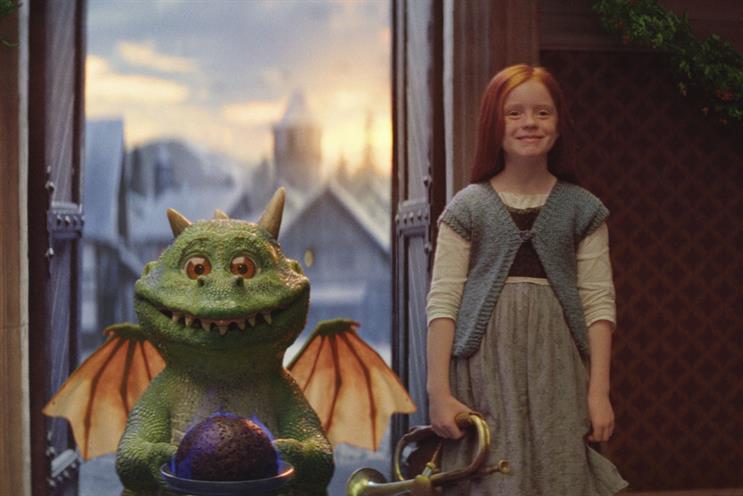
We remember it every Christmas, when John Lewis briefly reminds the industry that advertising can make people feel something. Or during the Super Bowl, when brands recognise that if millions of people are gathered for entertainment, the smartest thing you can do is become part of the spectacle rather than interrupt it.
But then, for some reason, we revert back to “normal”.
Back to chasing clicks. Back to confusing attention with affection. Back to optimising for interruption.
Partly because platforms reward it. And partly because modern marketing culture has become obsessed with proving the ROI of every single action – even when much of what actually drives long-term brand preference is difficult to measure precisely, immediately.
AI is only going to intensify this problem.
Because AI is about to flood the world with even more mediocre content, infinite ads, synthetic sameness and slop. And as that flood rises, audiences will become even more aggressive about filtering, muting, skipping, blocking and paying to avoid marketing that adds nothing to their lives.
Which means the brands that stand out won’t necessarily be the loudest – they’ll be the ones that contribute something. Something useful, entertaining or emotionally intelligent. Something worth the interruption. (Or that doesn’t rely on ‘interruption at all).
Because if advertising increasingly feels like a tax on being alive, people will do everything they can to make it disappear. And in that world, the brands that win will be the ones that understand a very old principle that suddenly feels new again:
Attention is easy to buy.
Affection is earned.