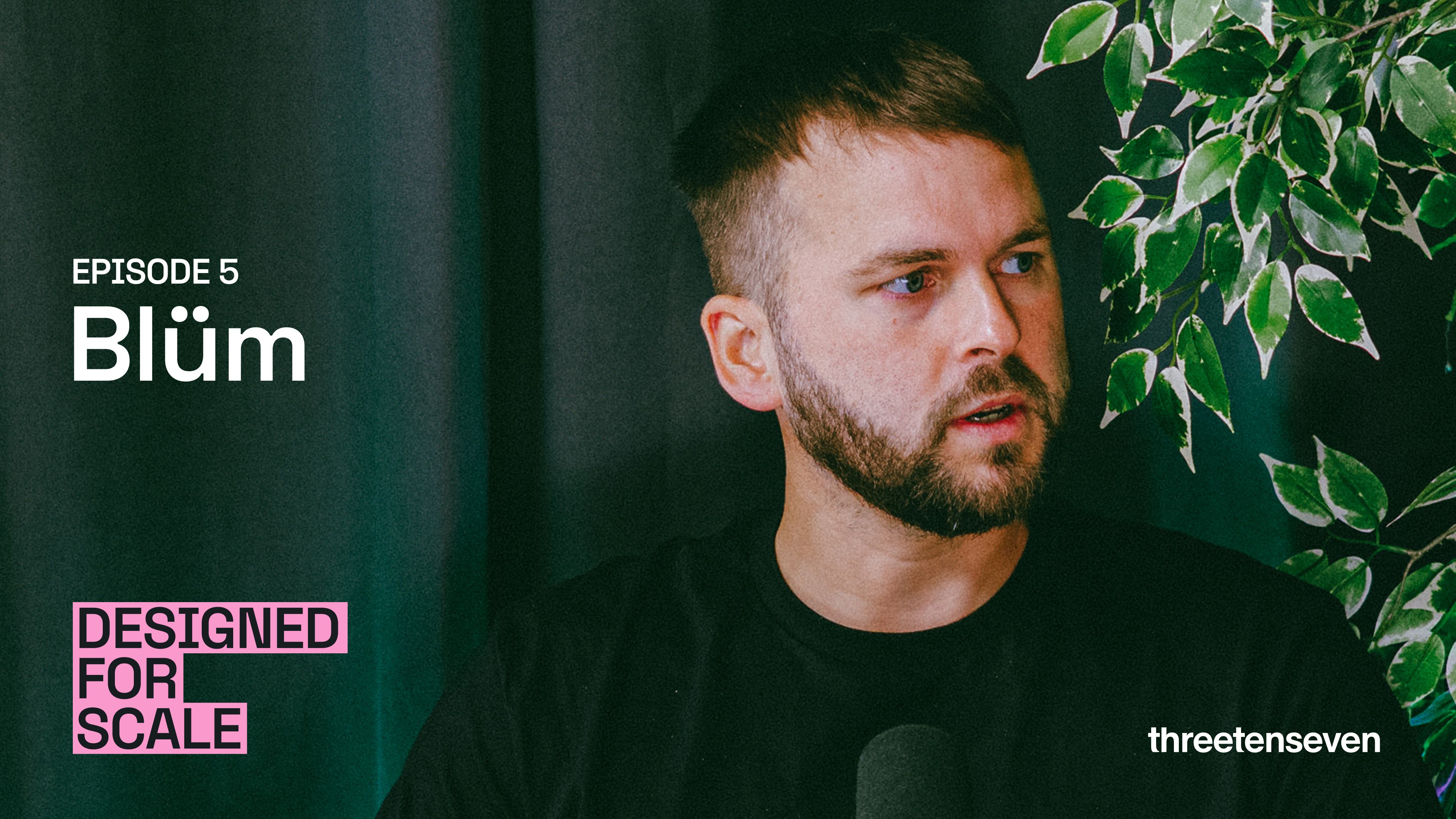
Episode 5: How Blüm wins NHS buy-in from patients, staff and finance
Blüm Health began as a baby app before COVID made it a one-stop shop for regulated digital health. Co-founder Dr Michael Watts on why health tech must win over patients, staff and finance, why you can benefit the NHS without selling to it, and why founders shouldn’t rush into AI as a medical device.
Rachel: Welcome to Designed for Scale, the podcast where we speak to CEOs, founders, and CMOs of health tech brands about how they built and scaled their health tech business. I'm Rachel Burrell-Cook, Managing Director of ThreeTenSeven.
Paul: And Paul McGuigan.
Rachel: And this time we're joined by Dr Michael Watts of Blüm Health. Firstly, thanks for having me.
Michael: I'm Michael Watts. I'm a doctor by background. So I've actually worked for the NHS since I was 18 years old, started out as a healthcare assistant, then made my way through med school. So care and healthcare has always been a big part of my life, adult life. And several years ago, saw an opportunity to build out new capabilities so founded Blüm. Back then it was called Blüm Baby because we were building a baby app, which recorded one second videos of your baby every day. And in return, they also documented developmental milestones, feed, sleep, that kind of stuff. So that's where the brand name came from. But just as we were about to launch, it was December 2019. And then of course, January 2020, COVID hits. We were like, nobody needs a baby app right now. Let's focus on COVID specific problems. So we were working on test and trace capabilities for care homes. We did really well in that. We managed to make enough money to build a small team. And then we started to work with NHS organisations to solve some of their problems. So we built a really nice speech and language therapy solution alongside a hospital down in Hackney. And what we thought was a COVID problem was actually just a big problem and actually that outlived COVID. So we started to realise that there was an opportunity to co-develop digital, data and now AI capabilities for life science organisations, whether it's hospitals, community care providers, social care, labs, pharma. But our USP, if you will, was that we had clinicians like myself in the team that could also support with some of the regulatory compliance and governance processes that a lot of small businesses in particular shy away from. So we sold the whole package of regulated software development capabilities. And as an extra stream to that, we'd also help with adoption and spread because we had a good NHS network. So we could effectively build solutions, get the regulatory compliance for them and then help with the adoption. So we were that kind of one-stop shop for digital health innovation. That's what Blüm started out as. That's still a majority of what we do, but we've also done lots of other things like product development of our own and internationalisation as well.
Rachel: So you've got products and services aspects of the business. What's the split like?
Michael: So a majority of our work and a majority of our revenue still comes from the services business. That's a very straightforward organisation — essentially the work comes in and the employee salaries go out. So that's quite nice because that's our backstop to all of the work that we do. It's a majority of the work that we're doing. But three or four years ago, we saw an opportunity to utilise some of that resource when it became available to build our own capabilities. We've done two acquisitions as well. So these have been companies that have a little bit of traction, but perhaps are not progressing or are failing. So we do a turnaround project with them. We retain the founders, we retain the IP, we retain the investors if they're wanting to stay on board, and we try and turn them around. And both of those projects have actually been quite successful. So we saw an opportunity to diversify our portfolio away from services by building products. That's still fairly new. It still accounts for a small part of revenue, sort of less than 10%. The goal as an organisation is for it to be 50-50 — not because we're doing less services, but because those products are now starting to serve populations and care service users.
Rachel: And that's meant that because you've got the engine room of the services business funding the product side of the business, it means you can self-fund those projects presumably.
Michael: Yeah, it gives us a few kind of rare capabilities. It gives us resilience because when the services business is going well, everyone works on them and the products sustain. But when we have service capacity, that gives us the ability to move our team onto the products so that we can progress those products at no additional cost to the customers really, because that's just something we should be doing anyway. So it gives us good resilience as an organisation and has helped with our growth. It gives us mobility. So if somebody needs a development team tomorrow, chances are we'll be able to resource that because we can just move people that are working on the products onto those services.
Rachel: So you effectively, in terms of structure — which I'm quite interested in — do you have a shared services team at the top of the business who are doing your core business services and then teams and developers effectively on each side that you can borrow from?
Michael: So we have a group company, Blüm Technology Group, and then we have Blüm Health, which is the business that everybody knows about, the brand, and that is the services business. So that is where all of the services are delivered out of. And then each of the products that we own have their own subsidiary company. So they have their own bank accounts, they have their own entity, they have everything that they would need. Yeah, exactly. Some of them have their own team, the more successful ones. Some of them just call upon resource as it's required, whether it's a salesperson, whether it's a marketing person, whether it's a developer. And we would essentially buy that resource off of Blüm Health and bring that in to do that work in the hope that that would then continue that product's growth journey.
Rachel: Just give us a sense of scale. That sounds like a lot of individual parts. What sort of headcount and numbers and locations are we talking about here?
Michael: So we're a team of 32. So across the organisation, there's 32 of us. Obviously most of those people sit in Blüm Health. It's essentially 70-20-10. So 70% technology — so AI and ML engineers, software engineers, designers, product owners, project managers. 20% clinicians and healthcare professionals, people that can support with regulatory compliance, data experts. And then 10% in sales, which is effectively me and a couple of people who go out and talk about the great stuff that we're doing. That's the kind of skillset mix. And yeah, most of those are employed. We have a couple of full-time contractors that we can kind of switch on and off. Again, that was another resilience play. For every person that we employed, we would have an associate back in the early days — a developer for hire effectively. So that if 50% of our contracts finished tomorrow, we would still be fine because we could serve notice, no one would in theory lose their jobs because they're contractors, and our employed team would keep our head above water. So we've always had that kind of approach to the team.
Rachel: Super interesting. We've gone the other way actually. So we've always had a much bigger core team, and we've moved to more of an associate model more recently because the type of our work is diversifying a lot. So we're finding it's harder to have full-time permanent staff who are covering all bases. We've got a really strong core team, but then bringing in the ancillary skills where we need it. But I suppose, is it because for you, have you just become more and more sure of the work and the contracts, the sort of type of work that you're doing that's allowed you to then bring more of that permanent resource?
Michael: Yeah, 100%. I mean, we know we're always gonna need developers and AI developers, project managers, and designers. That is the core of our business. We don't do much in the way of graphic design. We don't build games. So we would always just hire that skillset in as and when we needed it. But we know enough about what our vision is. And I think this talks to your point, Rachel — for a long time, we said we were yes men or yes people. We'd just say yes to anything and work out how to deliver it. We'd bring in the right skillsets. But then as we solidified our purpose and what we were actually in the market to do, you then solidify your team around that purpose. And then everything else becomes the, yeah, we'll commit to that and we'll see how we can deliver it and we'll bring in that skillset. And we're really fortunate to have good strategic partners around us as well. So we know that we can trust them like our own staff. They're gonna do a good job. And so at times it's better just to bring that resource and that skillset in rather than have it all the time. There's certain skills you just don't need all the time. Whereas there are other organisations that do have that skillset and they need it all the time. So yeah, I think that was one of the key elements as well — finding the right partners, building trust with them. But then also recognising that we as a business have to grow our team base. There are many benefits to having employees. There are obviously risks to having employees as well. So we always just manage that risk alongside the benefits. And as we've grown, so too has our headcount in terms of employed staff. And that's just a testament to, that's opened up so many more doors to the kind of bids that we can apply for, the tenders that we can qualify for. So it was always a balance of risk and benefit.
Paul: I think I've heard you talking about, when you talk about the sort of vision and the purpose, really talking about making sure that when you're working with partners and clients, it's about making sure that what they're developing is NHS ready or industry ready. And presumably a huge part of that is technology and interoperability and things like that. But there's other sides to it as well. So that's a bit more consultative — presumably sort of helping them to understand how to make their innovation adoption ready. So presumably within that skillset mix you're talking about there, it's not just technologists, it's sort of people consulting on the other aspects of making sure that things are ready to land.
Michael: Yeah, absolutely. We do that consulting on both sides. So we will advise — small businesses are the prime example. They will want to build AI as a medical device because they see that big vision, and they should have that big vision. The problem with AI as a medical device is it's expensive to build because it takes time — it can be capable, but to optimise it could take a long time to get it accurate enough and reliable enough to be able to serve patients or service users. And the medical device element therefore is also quite time consuming. So if you're talking, let's say an AI as a medical device project is three years and a million pounds, what we say to our clients is, "Well, have you considered software as a service that delivers a part of that?" Because you can get that out in six months and for fifty to a hundred thousand pounds, let's say. And then you regulate that as software as a medical device and then you automate that into AI as a medical device. So we try and consult back to the customer to say, "Yeah, you want this thing up here, but that's three years out of the market where your competitors might get a first mover advantage, they might be first to market. We know that being first to market is almost as valuable as being the best in the market because people don't like to change. So if they adopt your competitor first, even if you have a superior solution, they probably won't change because the pain of change is so high." So what we try to say is get out there, get your brand built. Trust is a massive blocker to innovation adoption. So if they trust your brand as a software as a service, then say, "Look, we're gonna take a bit more risk now for you. We're gonna be a medical device. Trust us, software as a medical device. Now we're gonna take out some of your resource so that your humans can go and do other things that were in their job description. We're gonna become AI as a medical device." Great, well, we're now three years down the line with your relationships with your clients, but you've had three solutions in the market. You've built trust over that time. You've been first in the market and your competition can't get in. So that kind of consulting, that strategy, that product development strategy is something that we try and support all of our prospective clients with to say, "You don't need to raise millions and millions today. Let's get going. Let's build something that works, let's build something that has that core ethos of what you're trying to solve. It's not gonna be able to fill resource gaps yet, but that will come — get it out there."
So we do that. And then we also do a lot of advisory work for countries. So ministers for health. We've recently done a piece of consultancy in North Macedonia, where we actually did a listening session, listened to some of the challenges that they had. We spoke about some of the opportunities that the NHS has brought. We spoke about some of the challenges that having a single healthcare service also brings. Who's responsible for what, how you move a patient through the system, how you keep patients out of hospital, how you reduce down the time that they're in hospital, how you try and make sure they don't come back — because those are the three points of innovation we see at Blüm. And people find those insights valuable. They also find the lessons learned from having a national health service really valuable. So yeah, we do a little bit of consultancy around, what is it that we're actually trying to solve here? Because too often do we see people finding gaps in the market with digital health. And then what I'll often say is, but there's no market in the gap. Because it's all well and good you being NHS ready, but actually is the NHS ready for you? And there's a ten year plan, and it quite clearly shows that the ten year plan isn't ten years long for all of the initiatives. Some of these initiatives aren't coming for another year or two. So you've got to make sure that your timing in terms of product development and investment align with your runways. Because otherwise you're going to run out of money before the NHS is even ready to consider you in their market.
Rachel: You mentioned a magic word, which is trust, which is one of my favourites — my eyes light up as soon as you mentioned it. How did you build trust in Blüm though? How much of that came from you as a clinician, for example, or did your MBA help with that? Tell us about how you really got Blüm to be taken seriously.
Michael: I think being a clinician definitely helps. You understand some of the challenges that we all face as patients — I'm a patient as well, like most of us are. So being a patient, being a doctor, being someone that understood the economics of healthcare, which I think does get overlooked in the UK. With every decision that we make as healthcare professionals, as care providers in social care included, there is money behind that that you just don't see. So we've become incredibly unresourceful. I could see the unresourcefulness. I could see the shift patterns — they just didn't make sense to me. So being able to understand that firsthand — it's the reason I still practise, because I need to continue to be exposed to our healthcare system to be able to really understand some of the challenges. I think an organisation in healthcare that doesn't have that firsthand experience really does struggle to articulate what they're trying to achieve to the people on the other side of the room, which will typically be clinicians as well as procurement and finance. But the clinician buying is absolutely critical to your success. So that definitely helped. And the MBA consolidated a lot of the learning. I was already two or three years into the business by the time I'd done an MBA. So that consolidated a lot of the theory around the economics of value. It made me realise how difficult preventative healthcare in digital would be, because how do you demonstrate a return on investment for something that you're not gonna see for five years? That's the usual lifespan of a small business. So learning the economics really, really did help.
But we really built trust by taking on some risk ourselves. So when you look at some of the earlier projects that we worked on, we would actually invest in some of those projects as well. So we would say, okay, if this project is costing, I don't know, let's say 10 pounds, give us eight and we'll stomach the two in return for a revenue share, a profit share or equity in an eventual company. So we actually own businesses with the NHS now. That was one of our first strategic moves that we made. And that built trust with them because they were like, well, these guys aren't just a development team for hire. They're actually part of the team now. They share the responsibility. If we run out of money, they're not gonna walk away. We very rarely do that anyway, but we do look for that next opportunity to help our customers and our partners grow. But that was one of our key success metrics — actually taking on a bit of the risk, having some skin in the game and sharing the tough times as well as the good times. Because the good times are always when they've won another grant or they've got the funding from a charity or a sponsor, that's always nice. But actually what they really care about is what are you gonna be like as an organisation when we run out of money? And by investing in these projects, we would still show up and we would still need to show up because actually there's some of our funding stuck in that project that we need to help get out. So that's how we built trust as a small business.
Now we're trusted through brand delivery — just being able to achieve things like mobility, productivity, our understanding of the clinical and healthcare industry really helps. And we've then expanded that internationally to say, look, we know what we're doing. If you're modelling your care on the NHS or in our social care environments, then we've been through that, we know that. So yeah, that's how we built. Building trust in the early years is the hard part, and then everything else follows through successes.
Paul: The other word you mentioned as well as trust is change. And you outlined a scenario earlier where, ideally, if you want somebody to adopt a change or a new innovation, best thing is if it's first to market. But a lot of the time it won't be — it'll be a sort of incremental, slightly better product for something that perhaps already exists in some form. What do you think the lessons are there for people innovating in health tech where they're not necessarily first to market with an entirely new idea, and they've got to shift attitudes and behaviours to adopt an incremental change?
Michael: There's a really nice saying that I always use at this point, which is that change occurs when the pain of staying the same is greater than the pain of change. And you can use that for any walk of life — if two people fall out of love, they're going to stay together until they get divorced because the pain of staying the same is greater than the pain of change. So whenever you're building a new solution for your stakeholders, the pain of them staying the same has to be greater than the pain of change. And that's really difficult because in healthcare, care professionals or in any care sector really, they're on their knees all the time, they're working long hours, they don't have time to do training and education on new technology. So whatever you introduce has to be easier than what they're currently doing. They have to feel the pain to want to change. So what does that mean in reality? It means that you've got to have a really clear value proposition. You've really got to show them that actually once they've adopted this, their life will be so much easier. They'll have more time back to spend with patients. They'll have less time travelling. They'll have less time doing admin. Whatever that is, you have to be really articulate and really clear that they're going to benefit from that.
Rachel: We talk a little bit about selling. We're obsessed with growth. And you talked very neatly earlier about those early days of getting your first few clients, and it sounded quite easy. And I bet it wasn't, especially because you're selling into, if we're talking NHS systems, a slow, risk averse system. How did you get those first few clients?
Michael: So being persistently patient is key. There is no real theory to sales cycles. Our longest sales cycle was 682 days. Our shortest was a week. So timing definitely helps. Being able to articulate, again, that you found a gap in the market and there's a market in the gap is really important because if you can articulate that, then people should want to hear what you've got to offer.
Rachel: Did you think you just happened to be in the market at the right point, back in the early days?
Michael: Back in the COVID times, people were scrambling for capabilities to be able to do things differently. So that was good for us because the virtual speech and language therapy platform that we built that I mentioned before — the problem there was that there were children still being taught at school in COVID that couldn't get access to speech and language therapists. They weren't able to go into schools. There weren't enough of them going into schools. So by the end of COVID, that was in 200 schools. Now it's in a thousand schools because actually the problem is that there just aren't enough speech and language therapists for the children that need that kind of support. So what we're saying is, let's not let perfect get in the way of great. Those children with the most communication needs still get in-person support, but there is a middle tier in the pyramid of children who have some needs that would benefit from teaching assistants having the tools that a speech and language therapist deploys at their fingertips digitally, to be able to give some support to those children that otherwise just get missed because they're not at the top of the pyramid. And the outcomes for them are really clear, which is why local authorities saw the benefits in terms of employment outcomes, behaviour, and that kind of thing.
So being able to articulate that is really important, but it was difficult because once COVID finished, what we then really said was, well, now we know what it takes to be able to sell. Clinician buying is really important, but it's no longer as important as it used to be. Twenty years ago, if doctors or nurses said, we need this solution, typically they'd say okay, we'll give it a go. Now there has to be real fiscal benefits. And healthcare or care is quite unique in that the consumer and the customer are usually very different people. The consumer will be a patient or a clinician, a healthcare professional. The customer is an accountant, a finance director, somebody that's probably never walked a ward unless they were a patient or doing a visit to the wards. So that's really challenging. You've got to get both on side now, in equal measures. Before it would be get the clinician bought in, bring them to the procurement conversation — really awkward because you've now got one of their employees on your side of the table championing your solution. But now it's 50-50. You've got to get as much fiscal buy-in. You've really got to demonstrate the economic benefits of your solution because even if it gives patients a nicer experience, that doesn't hold the weight that you would hope it does. I think we all hope that patients get the best experience, but that best experience also has to be underpinned by workforce efficiency, has to be a clear return on financial investment from a services perspective. So we learned really quickly that these solutions that we're building have to benefit patients, workforce and services. And they also have to meet the three shifts that we're talking about. So getting care into the community, prevention — which is still a hard thing to sell — and then also the sort of analog to digital, really clear digitisation methodology.
Rachel: And so much of what you're talking about is a communications challenge as well. And I try not to jump on the brand comms and marketing soapbox, but it's not enough to have just a good product. You have to be able to communicate to those different audiences so well. And that's what I've seen you do with Blüm — really speak to those different audiences. You know what you need as a clinician and you give that away in spades. But then also you understand the fiscal case for it. You understand the patient case for it. That's so important. I think that's been a big part of how I've seen your story come through. But I just see that so much with other businesses we work with — they're all focused on one of those two benefits, or three if we take the fiscal in there as well. They're just so focused on patients, which is wonderful, but to the exclusion of the people who are actually gonna sign off those cheques. Do you see the same thing in others?
Michael: If you're only focused on one of those three stakeholders, you will almost certainly fail. If you are just benefiting patients, but there's no clear workforce enablement or services benefit, whether it's fiscal or operational, you will fail 100%. It's the same with if all you're doing is creating serious fiscal benefits for the services, but you're really neglecting the workforce — the patients, they've got way more work to do to be able to do that, the patients just get left behind. Again, unlikely to succeed. Two out of three is not bad — I think there's a song in there — but if you're benefiting all three, that's a really good business because you've really understood all three stakeholders and appreciated them, but you've also given yourself the chance to speak to anybody about what you're doing. And once they're bought in, they can take you to the other two stakeholders. Speak to the patients and they'll take you to their clinicians. Speak to the clinicians, they'll take you to their finance director to say, look, we're behind this.
It doesn't make it any easier in terms of where that budget is coming from because again, budgets are usually preallocated, really clearly articulated on what they're gonna be spending money on. But it's important that you have all three of those stakeholders on side. If you're a patient-facing DTC business or direct consumer business, don't try and sell it to the NHS because the NHS won't be interested in direct consumer. They're interested in things that really benefit the organisation, keep people out of hospital, reduce down the time that they're in hospital and try and make sure they never come back.
Rachel: The ability to pull those cross-audience benefits together into a really compelling story is really important, isn't it? Especially because, as you say, with the rising power of procurement, unless it fits neatly on a spreadsheet in a numerical form, it's irrelevant information. Whereas if you can bring the right support, having people backing you and saying, I think this is a really great idea — not everything can be expressed in a numerical form. So having a great story, I think is just really important, isn't it?
Michael: It is. And I think the thing that often people overlook — and I actually did my MBA thesis on this — is selling to the NHS is difficult. I actually changed my thesis title to Introduce and Value to the NHS because one of the things I realised is that you don't need to sell to the NHS to benefit the NHS. There are ways to support the NHS without directly contracting with them. We always say, treat the NHS as one customer, one organisation, and you should really have no more than 10% of your revenue coming from a single customer. So what we have often seen is that people that build NHS-specific solutions will eventually fail or do fail unless they have met a brief perfectly and they're in the right market at the right time. If all they're doing is servicing a really unique UK-based NHS-based problem, you're gonna have a really tough time because your market already has a ceiling from day one and that market is filled with slow sales cycles, timelines — it's just a really tough business to grow.
So we say, well, build a solution that definitely helps the NHS but also helps the private sector, helps the third sector, helps the international markets. That is a good business. And never lose sight of the NHS. I think a lot of times we see people get so frustrated with trying to support the NHS that they just go, right, we're going to the US. And then that's equally as challenging — just different challenges. So what we try and say is stay focused on why you started what you're doing but think about other ways to support them. There are sponsors that will sponsor a solution that's benefiting the NHS because of the social value that brings. There are charities within the NHS that will part fund some activity. There are other ways of being able to bring funding in to support activities in the NHS. We've got one project that's entirely free to the NHS because we sell it internationally. So the international activity funds the UK-based activity. Now we're really fortunate to be in that position. It's taken a lot of hard yards and funding to get to that point, but it is a really good example of being able to still benefit the NHS — which I think is at our core — without having to directly just slog away at some of the challenging barriers that could be faced by particularly small businesses trying to get into the NHS.
Paul: That's great advice because things change so rapidly in terms of priorities in the NHS, don't they? Changing leadership at a political level, and being able to weather that change and pivot if priorities change.
Michael: I think the NHS does recognise that. I think Sir Jim Mackey, only at a conference this year, said no more slow nos. Like if we're not going to adopt something, let the organisation know. I think it must be a British culture thing tied in with the NHS approach to procurement — we don't like saying no. Like we probably like an idea, but we don't love it. So therefore we're going to say, yeah, maybe, maybe, and then no. For a small business, that slow no for a year could be the difference between making it and breaking it. So if you're not going to adopt something, say no, sorry, move on, go and find another organisation. We're okay with that. We'd rather have a no than nothing at all. And the other part to that is that as well as having fast decisions being made, being able to know who the right person is to go and speak to is as important. So moving away from the wrong kind of stakeholder and moving towards the right stakeholder.
Paul: Let's talk about export though, because it is a part of your strategy, isn't it? So how big a part is it? What's the split like across the UK versus rest of world?
Michael: It's a relatively small part of our current income, but it's a big part of our strategy. So what that means is we're investing more than we are making internationally because we see it as a great opportunity to put some of the amazing work that we've been doing, either ourselves or with partners, on a global platform. We've been really well supported by the Department of Business and Trade — DBT now they're called. They've been really supportive. And we've done it organically. And I think this is what is quite unique about us — we internationalised early. I think people are quite scared of internationalisation. They see it as the big world of healthcare and it is big. There's a lot to do, but that's great for opportunities. And there are lots of organisations that help guide you through the countries that you might be interested in supporting. And that's the other challenge — often when we're solving NHS specific challenges, sometimes it's quite difficult to drag and drop that into another market, especially where there's high private sector utilisation of care.
So we internationalised really early, got out there, started speaking to people. We've been going to conferences for four or five years without a contract because we knew that building relationships was important. And so we're really positive about that. So we operate in the US, parts of Europe, and then the Middle East. And it's really interesting because if you go to the West, often they'll be more interested in our services. So relatively speaking, our product development is cheaper than local development in the US. So they are often interested in our services. Again, our products don't always directly fit the US healthcare market. So that kind of makes sense to focus on services there. But going to the US is quite expensive to do. It's a big country, very competitive, so you need relatively big budgets. And we've seen people raise five, ten million pounds for a US strategy, come back two or three years later with one million and no revenue. So it is a really challenging approach, but a lot of people do it, which I don't blame them for trying.
And then if you go East, we tend to typically sell our products. So the cost of labour is often lower there. So therefore us trying to sell services to countries where the surrounding countries can offer product development and software development for a fraction of the price, that can be challenging. So we sell our products because our products come from the UK, so they are by default recognised in an established healthcare system. Often the compliance matters, they're regulated, they're high quality. So they like that. They also like the idea of something coming from the NHS and into their hospital. So we move our services West and our products East. And the good thing about East — so that includes Middle East, Far East, South Asia, Southeast Asia — is you don't have to raise a lot of money to do it. A lot of business is done through relationships and building trust with these organisations. So the reason that we go on these trade missions and these conferences every year, year in, year out, we see the same faces every year. And they come back and they say, you're the guys that have that maternity solution, aren't you? Yeah, yeah, we need that now. And let's give it a go. Let's pilot it. And if we like it, we'll buy it. And it hasn't cost us a penny other than the travel costs to build that relationship over the years. And they will remember you and they will think about you because you've built that relationship over the years.
So that's what we do. We have two strategies, one West and one East, both very different, both very focused, both with different business models. And so the advice there is, if you're a services business, go West. And if you're a product business, go East. It's not a hard and fast rule — it works for us, who have typically not raised a penny for our export projects.
And to flip that over just to finish on this point — because of our experience in the UK, our relationship with the NHS, relationship with industry, our relationship with some of the support networks like the Health Innovation Network, we also support international businesses that want to get a foot in the UK. So we'll often help them with their go-to-market strategy. We'll help them realise whether they've even got a market in the UK. And if they have, then we can help them with finding a pilot site, introducing them to the Health Innovation Network, that kind of thing. So we do that as well — a little bit of consultancy — in the hope that they will then need some integration support or some development support or some regulatory compliance support. So we do that as a bit of a foot in the door to that organisation that we then hope will build a longer relationship with us.
Rachel: Do you, to what extent do you have to adapt your pricing strategy for the different markets? Was there a lot of learning to do around that when you went into market?
Michael: We've always kept our costs fairly low. We're not in the sort of electronic patient record market, so we're not a backstop infrastructure player when it comes to products. These are usually products with a specific purpose, highly interoperable, relatively low friction to adoption, and therefore can be relatively inexpensive. So as a result of that, we haven't really changed our pricing from country to country, because what we should still be able to articulate is the return on investment for all of them. Now, yes, you could say where we're saying we can service all of the discharges for a maternity unit for the price of one administrator — of course, an administrator in South Asia is gonna be at a relatively lower cost than in the UK. But what we therefore then need to rely on is the principles that we've just discussed around the benefits for the patient, the benefits for the service as well. Because if we're only relying on being cheaper than an administrator, well, they're not gonna adopt us. So we have to revert back to our core strategy of what are the additional benefits, and if we can bundle all of that up into a price that is as competitive as our UK pricing, we should be fine.
We have had to discount some of the costs just because that's our way in. There are many benefits to a first contract in a country. And often they'll want free pilots. That's the other really frustrating thing — they want a pilot because even though you've got traction in the UK, you haven't got traction in their country. We also in the UK are really bad at that. We for some reason want to see some traction locally, even if you're a really successful international organisation. That can be really frustrating and you've got to do it, unfortunately, most of the time. So there are some risks that we've had to take. But we're in a fortunate position where we can afford to do things like free pilots. Recognisably it's really hard for small businesses to do that because that's just resource out of the bank that just is not going to have a direct income yet. But you often have to cross those hurdles and take a few risks.
Rachel: And you've got to really back your product then, haven't you, if you're going to do that — especially as a smaller business or a startup. It's risky.
Michael: Yeah, and I have seen organisations that will blanket say no free pilots — you've got to pay for our resources, we're confident in the benefits we'll bring to you. Fair play to them. I do back that strategy. And as I say, perhaps if we weren't in the position we were in where we can offer free pilots, we would probably do the same. But we just know that actually we're going to spend three months negotiating the deal, so let's just give them it for three months, start to demonstrate that traction and that will just help with the contracting process. It's not ideal, it's really not. But I've seen organisations that just back themselves and are doing really well out of it. And I rate that. I think we should all be doing that. And if you are not getting the response back of okay, yeah, we see the real benefits — don't blame the customer, blame yourself. You'll hear a lot of businesses go, oh, the NHS is bad to us, it's not buying us. It's not usually the NHS's fault. It's probably your fault because again, you've built something for one customer, the NHS. You haven't built the solution at the right time. It's not quite up to scratch. You haven't done your competitor analysis. You've been outcompeted. You can't blame the NHS for those problems. They are your problem. And you're the only person that can solve it. You're the founder. So again, I think that's one of the key things — having a really compelling product that is in the market at the right time. And if you're getting the responses back of free pilot, please — it's because they might want it, but they don't actually need it. And a product that is wanted but not needed is probably not going to grow as well as one that is a fundamental need for the industry.
Rachel: And that's also where the power of brand comes in because the stronger your brand, the more negotiating power you've got to say no to free pilots. The same crosses all industries, but the IBMs of the world are a lot less likely to be asked to do a free pilot because we know that the strength of the product has already been so proven. So there's a confidence about backing yourself, but also there's a bit of a chicken and egg situation here — you need the reputation to really have that confidence.
Michael: Yeah, and I think that's where, if you're in a scale up phase like we are, you're stuck between those two positions. As a startup, you might as well charge for a pilot because you've got nothing to lose. You're probably going to fail because you're a startup. Once you've made it through that chasm, you're kind of like, well, you're big enough now to have a reputable and recognisable brand. You can afford to give away a free pilot, but you can't afford to say, well, I'm IBM, so therefore you know we're the best. You've still got something to prove. And then of course, once you've exited scale up and you're a large enterprise, you're absolutely right, Rachel — people just trust that you're going to do a good job. So I actually think the scale up phase that we're in, and many businesses like ours are in, can be a really difficult position between a rock and a hard place where you're kind of dancing between being a startup and being a reputable brand. And you've kind of got to really gauge what the customer is thinking and predict how it's going to go, which is where the negotiation comes in, which makes it really hard for salespeople who try and stick to scripts.
And again, this is where being a clinician helps because you can talk their talk. So you can bring that little bit of an edge to say, actually, we understand you. Trust us on this, give us your money for three months and we will make benefits happen. I don't say it like that. (laughs) But you get what I mean. It just brings that extra layer of credibility that the brand won't carry. Does it get us to IBM? Absolutely not. But does it bring a little bit more than a startup does?
Rachel: Let's talk about that then. Last couple of questions. One that I'm really interested in is personal brand. This is a topic that I'm interested in personally and I talk to a lot of CEOs about as well. And I think it's your brand that really led me to you. Apart from the fact that a lovely lady called Jo, who's your non-exec, introduced us. But apart from Jo, I know you through Health Europe. There's a massive WhatsApp community for health — a thousand people in it, whatever the maximum is. I think you set it up actually, I didn't realise. And the boat party at HLTH and that sort of stuff. Your reputation precedes you. And I do think that's really important, particularly in scale-ups. But CEOs are quite afraid of it. Someone said to me yesterday, I don't wanna be all Donald Trump about this, but I do wanna concentrate on my brand. And I think there is a bit of that reputation that you can feel is a bit egotistical. And we all wrestle with that a bit, about putting ourselves out there. Do you recognise that personal brand is part of what has got you to where you are? Is it deliberate? And how do you feel about the Donald Trump-ness?
Michael: Thanks. I mean, I wasn't expecting that comparator. And it's not deliberate, to be honest. As a small business, often the product doesn't have traction. The brand doesn't have traction. The only person that either a customer is oriented towards or an investor is investing in is you. It's so cliche, but it's so true — they are listening to what you're saying and they are deciding whether or not they trust you. So your personal brand carries so much weight. Again, being a doctor massively helped. I got out to every conference. I was everywhere. And I've made loads of sacrifices. I've got two young kids at home and a dog.
Rachel: Yeah.
Michael: And there are times where I'm not at home when I really want to be, I should be, but I'm out there meeting people because we're an organically grown business. We can't pay to have the biggest stand at a conference. We can't pay to have loads of people out there networking on our behalf. So it had to be me.
Now that works to a certain extent. James and I, who founded the business, we have taken the business to a position where it's recognisable. The Blüm brand carries a little bit of weight. People see it without me there and recognise what it stands for now, which is great. But one of our biggest challenges that we discuss at board all the time is founder-led sales. The sale is still being done by me. I'm still the person that can challenge the person on the other side of the room who says, "No, we don't need this." And I say, "Well, actually you do because of X, Y, and Z." And there's clinical credibility behind that. Really hard to replicate that in general sales where the salesperson doesn't have that clinical expertise.
But actually in our sales team, the best salespeople that we found are those that have come from outside of healthcare into healthcare and brought a manufacturing mindset or something like that. Because I think when you're in sales in healthcare, it can be quite demoralising, especially in the UK. It can be slow. And they've got a slow sales cycle mindset. So we brought in people from manufacturing where they expect things to happen in days. So at least they're fresh for now. Hopefully they don't get too demoralised too fast.
So trying to offload some of that personal brand weight into the team has been a real challenge. It takes a long time. You can't really articulate how you do what you do — I just go out there, I speak about what we do. And if you like it, use us. We don't do SEO. We get very few leads through our website because our website is really a point of information. By that point, they've already heard about us because they've seen us at a conference or they've spoken to me at an event or spoken to someone on our team at an event. Or one of our customers has said, go and speak to Blüm.
And we're now recognising that that is great to a point. But for scale, we do need to have website marketing and AI marketing capabilities. We do need to have proper brand guidelines and all these things that a proper business has. So it's an exciting time for us because we're going through that motion where the business will not continue to grow if I continue to operate as a personal brand around the business. So that's quite exciting. It's scary because as a founder, you have trust issues. I think this perhaps talks to the ego point — James and I have built the business around us and we've brought in great people and we're now having to let some of that responsibility go.
Paul: That's the bit that people forget, isn't it? People think brand is there to help you sell and help you scale. It also buys you some forgiveness because people have trust in the brand. You've built that equity. When things go wrong, you've got some forgiveness. Whereas if you've got no brand...
Rachel: Well, I think it's probably a good time to wrap it up, but I have got loads more questions that we'll finish up on afterwards. But the last question — the one that we ask all of our guests — who do you think we should speak to in health tech? Who's a leader with a really good growth story that you think we should speak to next?
Michael: I'd actually recommend two people. They're both women in healthcare. So one is Gemma Paul. She's also from Nottingham, so there's some kudos right there. She's a midwife and she's been working on supporting women from minority ethnic communities in maternity — really trying to change the dial on a really important topic, probably more important than ever right now. She's had a fantastic growth journey and she's made massive impacts for the NHS.
The other person is Caroline McCallum. Again, she's a speech and language therapist. She's who we partnered with on the speech and language therapy project. She still works full time for the NHS and she's run this organisation, this project, almost as a side hustle, but it's in over a thousand schools and it's generating a lot of revenue. Perhaps one of the most successful clinical entrepreneurs that I've ever come across. And they're both fantastic examples of people that are healthcare professionals first, innovators almost second, but sharing both passions and responsibilities equally. And therefore making the most amount of impact whilst staying true to their core ethos, which is looking after women, parents, and also children. So they're two really great examples of some of the best projects that we've seen — and we've worked on both of them as well. So really, really good projects.
Rachel: Fabulous. And thank you for nominating women. That's particularly cool and needed. So really appreciate it.
Michael: That's okay.
Rachel: Thank you so much for joining us. It's been a treat.
Michael: Thank you for having me.
Paul: Thanks both.
Michael: Thanks both.