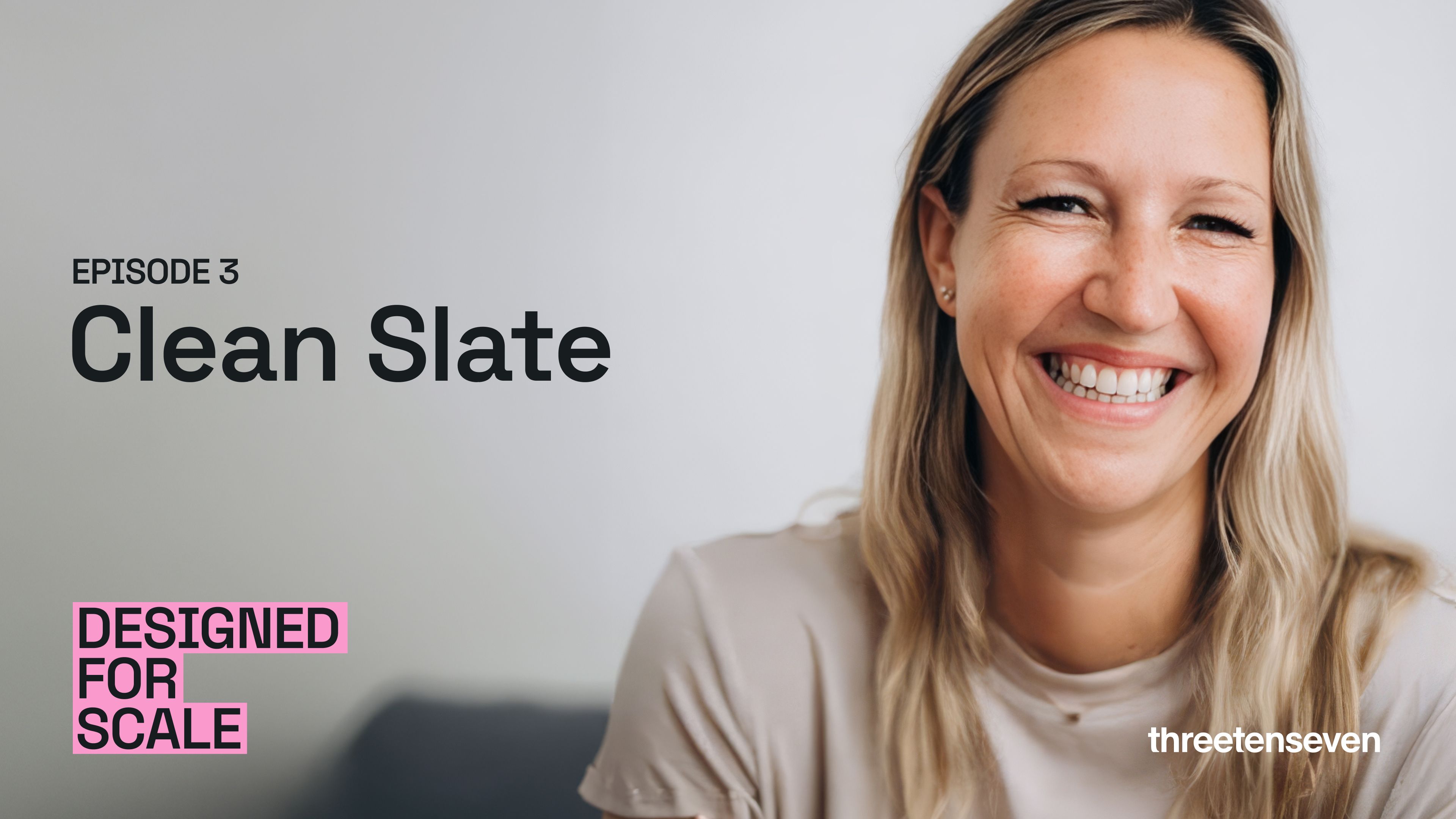
Episode 4: How Clean Slate scaled its mission from Australia to the UK
Clean Slate is a social enterprise on a mission to tear down barriers to addiction treatment. We talk to Co-Founder and CEO Pia Clinton-Tarestad about building a values-driven business in one of healthcare's most stigmatised spaces, why their 7% relapse rate is actually a harder sell to some investors than you'd think, and what it really takes to go from accidental founder to closing a Series A.
Rachel: Hello and welcome to Designed for Scale, the podcast where we speak to founders, CEOs and CMOs about how they built and scaled their health tech brands. I'm Rachel Burrell-Cook, Managing Director of ThreeTenSeven.
Paul: And I'm Paul McGuigan, Strategy Director at ThreeTenSeven.
Rachel: And this time we're joined by Pia from Clean Slate. Pia, would you introduce yourself?
Pia: Happy to, yeah. I mean, other than being obsessed with dogs, which you know a little bit about already. So I'm Pia, I'm the co-founder and Chief Executive at Clean Slate Clinic. Clean Slate Clinic is a social enterprise with a mission to tear down barriers to accessing addiction treatment. Our vision is to reach a million families and change the paradigm of addiction to one of hope and lasting resilience.
I'm a health economist by training. I trained as a health economist in Sheffield, North of England, where I spent 10 years working in the National Health Service in different roles. So I was a project manager at the hospital. And then I've been very interested in impact for quite a long time. I think that stems from experiences working as a medical secretary way back when and just seeing the harsh impact that socioeconomic differences can have on health outcomes or health literacy can have on health outcomes. So seeing people with diabetic foot coming in for avoidable amputations in hospital got me quite passionate about health equity and outcomes. So that's why I trained as a health economist.
Clean Slate came much later. So I'd spent, in total I spent 13 years in the National Health Service in the UK, realised I wasn't cut out to be a bureaucrat, went into consulting, spent six years in consulting. The last four of those were in Australia. And through a combination of factors, I was the lead partner for healthcare in Deloitte in Australia, ended up quitting my job in burnout and alcohol dependence in 2020. And that's what led me to Clean Slate Clinic. So my own personal experiences of the barriers to accessing support got me really interested in the area personally. Professionally, when you look at the scale of harm from alcohol and other substances and how that is unevenly distributed across communities — not because prevalence is different, but just the harms are disproportionate in marginalised communities — interested in it professionally. And then my best friend, who's my co-founder, serendipitously had rung me the day after I quit Deloitte and asked me if I would help him. And he'd been trying to set up some sort of model of GP-led support for alcohol dependence. And that's where Clean Slate started.
Rachel: Wow, that's incredible, isn't it? These moments of serendipity, as you put it, where just the right call comes at the right time. So Clean Slate's been around since that call essentially — that was when the business came into being. Can you talk us through the growth of the business since then and what kind of size and scale you're at now?
Pia: It's been a wild ride. Let's put it that way. So we started — the business actually, we formed as an entity in November 2020 with really no idea of what we were doing. We didn't have any patients yet, but we did all that stuff and insurance and so on. And we actually started our first contract, which was a government contract, in July 2021. And in that first year, we did a pilot of publicly funded patients of 50. And then by towards the end of that year, we got a contract with Bupa in Australia and had a few privately paying clients. So we did 78 clients in total that first year.
So that was five years ago at the end of, or at the beginning of last month. Now we see about 78 clients every week in Australia and we launched in the UK in January of this year. So I guess you could say we've grown — whatever it would be, 78X, 52X, sorry, 52X, that's the maths.
Paul: Yeah, I thought it was really interesting when I saw that you'd got your own podcast and tactics like that, not just about treatment, but they're about normalising conversations and tackling stigma and things like that. And I was interested in what your thoughts are around the things that need to happen in order to break down stigma and build trust for people to approach an organisation like Clean Slate — because that's ultimately what you need, right? To be approachable, break down those barriers and hopefully get to a place where, as you say, mental health fortunately has got to where there's far less barrier to people reaching out and seeking help.
Pia: Advocacy — I see it as, if we want to achieve our vision of changing the paradigm, then advocacy has to be a core part of what we do, irrespective of how many people come and get supported by Clean Slate Clinic. So that sort of advocacy, raising awareness role is really important. I think helping people to see the different faces of addiction, because again, if you look at the popular media, the representation of addiction is generally rock bottom. It's often — certainly my sort of image was brown paper bag, park bench, that's what alcohol dependence was. And so I think sharing stories of alcohol dependence — it can be affecting your work, your relationships, your health and be completely invisible to the rest of the world. I think just sort of sharing those stories so that people recognise they're not alone, and also that it's not a moral failing, it's a health issue. I think it's critically important.
One of the things we hear very often from our clients is the things they value the most about our approach. We do groups as part of our approach, and realising that they're not alone is huge. So most people who are struggling think it's unique to them, there's a huge amount of shame. And so I think the best way to tackle shame is discourse and actually talking about the realities of life struggles — coping mechanisms as part of life struggles are unbelievably prevalent — so that people can recognise themselves in the stories that we tell, and that helps to break down those barriers.
Rachel: How do you get from there then to someone feeling like they want to get help to actually commercialising this? How does that happen? How did it happen first of all in Australia, and then how does that differ to the UK market?
Pia: Luck and serendipity have had a lot to do with our journey. I wish I could say I was some sort of commercial strategist that from day one knew exactly how we were gonna make this work. We just genuinely started with the mission to tear down barriers and then found our way, stumbled I guess our way to what we have now.
The first thing we had was a Primary Health Network, which is a small commissioning body for a local area in Australia. They had a problem in their area that they wanted some help with. My co-founder Chris had been speaking at a lot of clinical innovation forums and so they were quite interested, once we set something up, to trial it for their population. It's sort of part of central Sydney that's got high affluence but also high prevalence of marginalised communities as well, particularly LGBTQI+. So trying to find a model that would tear down some stigma was a priority for them. So they funded the initial pilot and we literally just — on a notepad, working down the calculations — okay, how much, we'll have to recruit a couple of nurses, we're gonna need this many hours — just bottom up to what it was gonna cost to deliver this project and do an evaluation. And that was the first sort of commercial undertaking.
As we got going, we started to get a feel for what it was gonna actually cost to deliver this at slightly bigger scale. Put it this way, we wildly underpriced it to start with because the infrastructure that you need to do this at scale is quite significant. And so we revisited our pricing and then we did our first contract with Bupa. We charged a little bit more because we knew it was gonna cost us a bit more. And that's sort of how we found our way to where we are today.
We always had as a design principle that one of the barriers to access is affordability. So whatever we do commercially — yes, we're a social enterprise, a commercial social enterprise, we have shareholders, they're all impact investors, but shareholders who back us, we have a responsibility to be financially sustainable. But financial affordability is a key barrier. So trying to tread that tightrope of how do we make something that's commercially viable but also financially affordable. Part of that is about being really smart around designing an efficient and cost-effective solution and then being able to price that appropriately.
So that's sort of the approach that we've taken. And we've learned so much along the way around what things cost. And so coming into the UK, we were much better positioned. We may not still have it exactly right, but much better positioned to know what this is actually gonna cost to deliver at some sort of scale.
We did the reverse coming into the UK that we did in Australia. We started with government and a private health insurer came on board, and then we started selling direct to consumers. In the UK, we've come in selling direct to consumer first, just because we know the sales cycles for government and for private health insurers take a lot longer. And we've been around and well-known in the system in Australia — we're brand new to the UK. So we've got to build that trust and reputation here as well.
Rachel: It sounds like from what I've seen, you've been able to then demonstrate great value and return on investment, because the outcomes have been fantastic, haven't they, compared to traditional services. Talk to us a little bit about the results that you've seen and what that's meant — that you've been able to then take those results and present those in a way that means you can continue to show the value and help you grow.
Pia: The outcomes have been phenomenal, probably beyond all expectations. To be fair, for Chris and I, we just wanted to break down the barriers. We hadn't thought as far as what the clinical outcome is gonna be. We knew we wanted to measure them because that's important to us. And we knew we wanted to measure them over the long term.
So we've had our service independently evaluated by Sydney University — that initial pilot. And that had a month one post-detox 2% relapse rate and 84% of clients fully meeting their goals. So that's pretty good.
We now capture all of our own data internally. We have thousands and thousands of clients go through the programme. So we measure it at three months, six months, nine months and 12 months. Probably the fairest metric to compare — and I will give you all some caveats around the data — would be the three month mark, because that's kind of what the public sector compares, the 12 week treatment. So at the three month mark, we have an 80% client retention and a 7% relapse rate. In the public system in the UK, 62% of people have either left treatment or relapsed at that same sort of 12 week mark. So it's a phenomenal difference.
Now, the caveat that I would give is obviously selection bias — we might have clients who are more motivated coming to us. All sorts of reasons why we might be getting better results. But by whatever measure you cut those results, the return on investment for the individual, for their family and community, and for society and the economy, you'd be hard pressed to find a more cost-effective thing to do.
Paul: It's incredible. Congratulations on the impact that you're having. It's absolutely fantastic. And that must be brilliant evidence to have in your back pocket when you're looking for investment, when you're looking for new authorities or territories to partner with. It must have absolutely supercharged your ability to grow, yeah?
Pia: It depends what kind of investors you're talking about, because some investors are like, oh, where's your recurring revenue gonna come from? All these people are getting better. So there's a certain type of investor who kind of maybe doesn't love really, really low relapse rates. And that's just a fact of how some of the financial investors think about long-term returns. My counter to that is the amount of trust that you build with somebody when you can safely support them through detox and long-term resilience building means that you've got a customer for life and whatever you want to support them with next. But certainly in terms of building relationships with insurers, with GP practices, with the rest of the sector, then absolutely those outcomes give us credibility and the opportunity to have a seat at the table.
Paul: Do you think it is the clinical outcomes that's really led to your growth, though? Because they really are impressive. And I'm sure there's something that's specific about the model — the home-based model being really valuable. But there's also the fact there's you behind the brand and you're quite different to that man that I would imagine with a brown paper bag. And I would imagine a man, I think most of us would, because that's the stereotype around addiction, particularly alcohol. So I'm wondering whether there's something about you and your brand as well that's helped, or the way that you've positioned Clean Slate that's led to the growth just as much as the model?
Pia: Yeah, I do think there's something in that. I'd love to go off and do a PhD and try and analyse the data in depth and really understand it, because I find it fascinating. But for example, 60% of our clients are female. That's extremely unusual in the addiction treatment sector — it's usually the other way around, 60-70% of clients are male. And so I do think there's something in it being female-led. I obviously made the decision early on to share my own story, which was pretty terrifying at the time, but I thought, I have to lead by example here. And if we want to break down stigma, that's what we need to do. And so obviously that story came out there in our early phase of growth in Australia.
So yeah, absolutely, I do think that's helped. And we've continued that tradition, let's call it, of sharing stories. And when our clients feel ready or if they would like to share their stories, continuing to put out that breadth of representation for people who may struggle with alcohol or other substances. So yeah, I do think that's helped.
But certainly the model is a lot of it as well, in that just providing an option where you might have caring responsibilities — we have a lot of healthcare workers in our service, for whom there are extra layers of stigma. Those are the groups that I think find it really difficult to go to traditional treatment. And we do provide an alternative that simply wasn't there before.
Rachel: And also something about the lack of religion. AA is a faith-based treatment as well, which turns some people off. It has some mantras about it — always an addict — that maybe don't align with people. Whereas I appreciate that yours is more faith-agnostic, certainly. Is that right? Have I got that right?
Pia: When you subscribe to it — I'm gonna take the words from one of my inspirations. So Sheena Wan, she was Australian of the Year a few years ago. She has her own lived experience, came through the AA model, and we're not anti-AA at all. But what she says is, whatever works, work it. And that would be the philosophy we subscribe to as well. So one of our core values is inclusivity. And so if you want to come in and you find it helpful to identify as an alcoholic, go for your life if that works for you, but we're not gonna label anybody. If you have committed to never touching alcohol for the rest of your life, fantastic, we can work with you on that goal. But if you haven't quite decided yet, but you know you need help right now, no problem, we'll work with you. All we ask is that if we're doing a detox with you, we commit to at least three months of abstinence, so you give your neural pathways a chance to reset.
So we follow the evidence, but by design, it's absolutely judgement-free and inclusive. And I do think we speak to people who've tried AA and it hasn't worked for them. I think AA, sometimes AA can come down to the individual group — it's moved away a little bit from being purely religion-focused, and your higher power can be anything at all, it can be the ocean, whatever. But it doesn't work for everybody. And I'm sure we wouldn't work for everybody too, but it's just about having choice and option.
But we're very much around self-management, autonomy, resilience building, and avoiding labels. I have a personal passion to avoid the othering of someone who's — whether you're sober, whatever you want to call it, whether you're sober, in recovery, have had a problem in the past, doesn't really matter. You're not different to any other human. You've just had a different set of experiences from the person next to you, as has every human on the planet.
Paul: I find it fascinating how much of the approach in this space relies on language and thinking about labels and moving away from harmful clichés. And it sounds like you've just navigated that in a really original and successful way that has made the whole approach of Clean Slate feel that much more inclusive and that much more approachable. And it's just, as a communications person, I find the role of language and thinking about labels really interesting. And you've obviously struck upon a way of dealing with it that's really resonating with people.
Pia: We try. It probably helps that we're a queer and a female co-founder, do you know what I mean? So we're kind of like — I don't know, call us a bit woke if you want. But I think we're quite thoughtful about labels. And Chris has had his own experience growing up with homophobia and coming out. And so I think maybe we just have a little extra bit of awareness around it.
At the same time, I do think you can tie yourself in complete knots. So at some point, if you go too far down the rabbit hole of language and trying to be inclusive, you can end up actually not making sense anymore because you're too scared to use any words. So it's just finding the right balance of — if the underlying values are undeniably about inclusion and accessibility and zero judgement, then you have to put a layer of pragmatism on top of that, I think. So I still use the term addiction because I don't know what else you would call it. But some extreme schools of thought would say we shouldn't use that term anymore. So yeah, it's a tightrope to walk, I guess.
Rachel: Yeah, that sounds like a really sensible approach. So just to tell us a little bit about the commercial side of things — in terms of where you're at at the moment, am I right in thinking you're going into a raise currently? Where are you at on that funding journey?
Pia: We are in — I don't know how to describe it — we are in the death throes, maybe, yeah, the death throes of our Series A. So we're like term sheet, just putting the ink on the term sheet, and so we'll get that closed in the next couple of months. And that would be our Series A done, which is super exciting and will support us on the next phase of growth and impact.
Rachel: Fabulous. And just talk to us about where — what kind of levels of funding are we talking, and what's the makeup, what's the investment backing looking like?
Pia: Yeah, so we're targeting a £10 million raise. This one will land somewhere between minimum five and maximum ten — we think towards the upper end of it. And that's made up of some new institutional investors coming in, our existing investors continuing to support us strongly, which we're so grateful for — we've had them on the journey for a couple of years now. And then it's a mixture of foundations, some impact VCs, some individual high net worth investors. So we're very lucky to have a really genuinely wonderful group of supportive and values-aligned shareholders. It looks like that's gonna continue through this Series A raise, which I'm thrilled about.
Paul: Do you think it is luck or is it product? Is it you? I don't often believe in luck, that's all.
Pia: You're right, of course, it's not luck — that's a fair call. I think it's partly the product. So the example I gave you around recurring revenue — if you're ruthlessly commercial, you'd be much more interested in a rapidly growing addiction clinic with a 70% relapse rate. So it makes more commercial sense to have the same relapse rates as the existing system, but just do it more cheaply. And do it in a way that delights customers, but keep the relapse rate the same. That is more commercially attractive because then you can have a recycling of customers, it's much cheaper to acquire a customer, you get recurring revenue. So I think that definitely will have the product create a bent towards people who really care about impact. So we go out and find new clients every year, and then that has this huge ripple effect into their families and communities, and that's how we change the world over the long term. So if you care about impact, you're gonna be attracted to what we do. And if you're ruthlessly commercial, you'll immediately request recurring revenue.
I think — and I know we might talk about this a bit later — our entry into fundraising came through the Snow Foundation Social Entrepreneurs Programme. That's probably the thing I'll be most grateful for in my life when I look back, the support of that organisation. But obviously then, that trust is built through their networks and their networks are impact-aligned, and those networks are then also impact-aligned. So you're sort of in this ecosystem, this impact ecosystem, and that then sort of attracts like-minded and values-aligned folks. So probably to do with that as well.
Also, I'm a female founder, so who's gonna give me money? Like bloody hard to get anyone to give me money. So yeah, that's probably part of it as well.
Rachel: I think also that's why I said, is it luck? Because as a female founder, I also know that it's very easy to be self-effacing and say, I'm just lucky, when actually you've worked incredibly hard and you've done an amazing thing. But I feel like men are less likely to do that. So I also have to do the poke to another female founder, basically.
I think I saw you on another podcast describe yourself as an accidental founder. So you speak incredibly knowledgeably and eloquently about the commercials, but it must have been an incredible learning curve to get to where you are now. So what have you learned on that journey from health economist and consultant to accidental founder — if that's the right term — that would be useful to people who find themselves in a similar position?
Pia: It's funny, I was reflecting on this just the other day. I'm actually, technically, a second-time founder, because when I left Deloitte the first thing I did was set up my own little consulting firm. And that ran merrily and was much more lucrative and much easier for me personally in terms of the financial returns than doing Clean Slate Clinic. But I guess I didn't really consider it to be founding because I was just doing what I'd always done, but doing it by myself a bit. But actually technically this is my second time. So that's probably another female thing — I should start relabelling myself as a two-times founder.
But the reason I describe myself as an accidental founder is that Clean Slate Clinic was not something I was looking for. I didn't leave Deloitte and think, right, now I'm gonna go and set up something. I fell into it because of my lived experience, that phone call from Chris. And we had a third co-founder when we started this journey who had very high confidence we could do something. So I sort of got on the train, if you like.
And I remember us having a discussion like six or seven months in, because we got to a point where we had a contract and we started to need titles — because we'd just been like, this is what I described as an expensive, very expensive hobby for a while. So it was just turning from an expensive hobby into a going concern, like we need titles. And so that's how I — the boys ganged up and said, "Pia, you should be the CEO." I was like, "Oh, fine." But I didn't really think it meant anything. Like I had no concept of where we were gonna take it. It was just all a bit of fun. So yeah, that's being an accidental founder.
In terms of what did I learn — some of the core skills and characteristics that make you a successful consultant or successful in the NHS apply equally to being a founder. Tenacity is, I'd say, probably number one. If you don't have that, really don't bother. It's gonna be way too hard. So tenacity and stubbornness, probably really important.
I think the things that I wish I had — I probably wish I'd sat down and read some books beforehand about building and scaling businesses. There are some great books to read. Pricing strategy — when I was doing consulting, I worked mainly on the public sector side because that was obviously my background. So I didn't have much experience of what the private sector looked like and how it operated. So pricing strategy was probably a blind spot. Growth strategy, marketing. But the joyful thing about being a founder is I love learning stuff. I think that's the best thing about this job — constantly being at the edge of my capability and having to learn the next thing. So yeah, be prepared to learn, but if you're up for it, it's a wild ride, but it's a fun ride.
Rachel: I think we need to come back and talk books because I love learning about new books. So I'm gonna message you afterwards — just prepare a long list for me, please. We'll share them with people.
But just to bring us home really, we've got a couple of last questions. The first of which is really around that £10 million raise — what's it gonna lead to? Where is it gonna take you? New markets, new products. What can you tell us?
Pia: Oh yeah, lots of exciting stuff. So there are three key areas of focus for me going forward. The first is to get the UK to where Australia is now, which is effectively a stable, growing, healthy, largely autonomous market. Australia — I have an amazing team, it basically runs itself, it's growing really well, the impact they're having is amazing. So phase one is get the UK to that same point.
Phase two is on the technology. So we built a platform and rolled it out across two markets whilst we were flying. And that's not easy in a highly regulated environment because obviously there are non-negotiables around GDPR, data security and protection — we're dealing with health information. But really we built a platform that works brilliantly well for 5,000-10,000 clients. What do we need to have in place for that to work even better for 20,000, 50,000, ultimately a million? So there's a big piece of work around the global backbone, as we're calling it, that's in readiness to move into new markets beyond the UK. So as soon as the UK is at stable, predictable growth, I have my list of where we're going to go next. Because to reach a million families and change the paradigm of addiction, we need to be a multi-market play.
We're building a clinical academy, which I'm super excited about. The alcohol and other drug sector is losing 19% of its workforce every year in the UK. I do not want to be a drain on that sector's workforce, I want to be a contributor. So we want to build a clinical academy so that we can train our own clinicians up, who can then grow and go out into the sector as well as coming in — creating more workforce capacity to benefit the whole sector.
I said three things, I'm probably on about five already, but the last and really exciting one is building our — so we acquired an app earlier this year, called Curb. And we're just in the process of re-skinning that and integrating it into our clinical services. But there's so much that can be done with that app to provide support to people in between their appointments. I'm a strong advocate for clinically integrated AI — having the technology and the clinical pathways really hand in glove, and building the AI features that enable us to better support people both between appointments and ongoing into the longer term. So that's also on the roadmap. So we're gonna work that £10 million pretty hard.
Rachel: You've got a lot to do. It sounds super exciting. You're also at the point that I love — which is something where Paul and I often get involved in debates — which is how you keep your proposition really clear and not muddled as you move into, for example, the clinical training, et cetera. It can be really easy for that sort of thing to dilute or distract from your core mission, even though I appreciate that it's all driving towards that same mission. It can be so easy to put out distracted messages, and having the discipline to stay really focused on your core proposition will be really important at this point — to make sure that people, particularly people with money who can buy your service at a procurement level, really get the thing that you're selling and that you're out to deliver to them. Distraction is often the mother of all hiccups at this point.
Pia: I think yeah, there's a lot of work to be done under the hood, but I think outwardly facing, absolutely that core proposition mustn't change — which is accessible, affordable, highly effective care for people struggling with alcohol or other substances. Always.
Rachel: Yeah. The final question we always ask everyone really is, we love to take recommendations for future guests — anybody who you think might have a story worth telling. You've had a fantastic story to share with us today. If there are any other founders, CEOs, CMOs or marketers who you think we should approach to talk to us about their growth story, who have you met or come across?
Pia: I can give you a few. There's one from Australia who I've met recently because we have an investor in common — CEO of a company called Baymatob, Tara Croft, and that's a women's health technology. It's a device that monitors pregnant women and can prevent complications during birth. It's life-saving, it's an amazing device. And I think Tara and her team have raised like $27 million to drive that forward. They've got clinical trials going in the US. They've done an amazing job.
In the UK, I admire the tenacity of Chris Edson from Second Nature. So Second Nature — we're alumni from Deloitte, I don't think we ever knew each other at Deloitte, but we have a colleague in common who introduced us. And he's sort of built a weight management and behavioural change app, which was built long before the GLP-1 thing — of course they're now integrated with it — but has done a brilliant job, I think, at building reputation and navigating NHS procurement, all those sorts of things.
And then I'll throw one more out, which isn't a health tech founder, but — and I don't know if you have something like this in the UK already — two doctors, Amandip Hansra and B. Mian, set up something called Australian Medical Angels, which was an investor syndicate just made up of doctors originally. Now it includes all healthcare professionals in Australia and they invest in health tech. So they're growing the ecosystem. I think they've invested in 42 companies, including us, and not one of them has failed so far. And I think that says something about their investment thesis and the insights they have in backing credible clinical impact businesses. And they've just launched their first fund, moving from syndication to fund. I think they have an amazing story to tell as well.
Rachel: Wow, fantastic recommendations. Thank you. You came straight off the top of your head as well — I love that. Well, definitely check them out. Thank you so much. In fact, just thank you generally. It's been so great hearing your story. I really, really am so excited to see where you go next with this raise. It's just really cool what you've done, but also I love what you're doing with trying to reverse the stigma that exists around addiction. The fact that it's come from your personal story and so much good has come from what must have been a really dark time — I think it's just amazing. So thank you so much for sharing the story. Good luck with the raise, and we can't wait to see where you go next.
Pia: Thank you, thanks so much for having me.
Paul: Thank you.