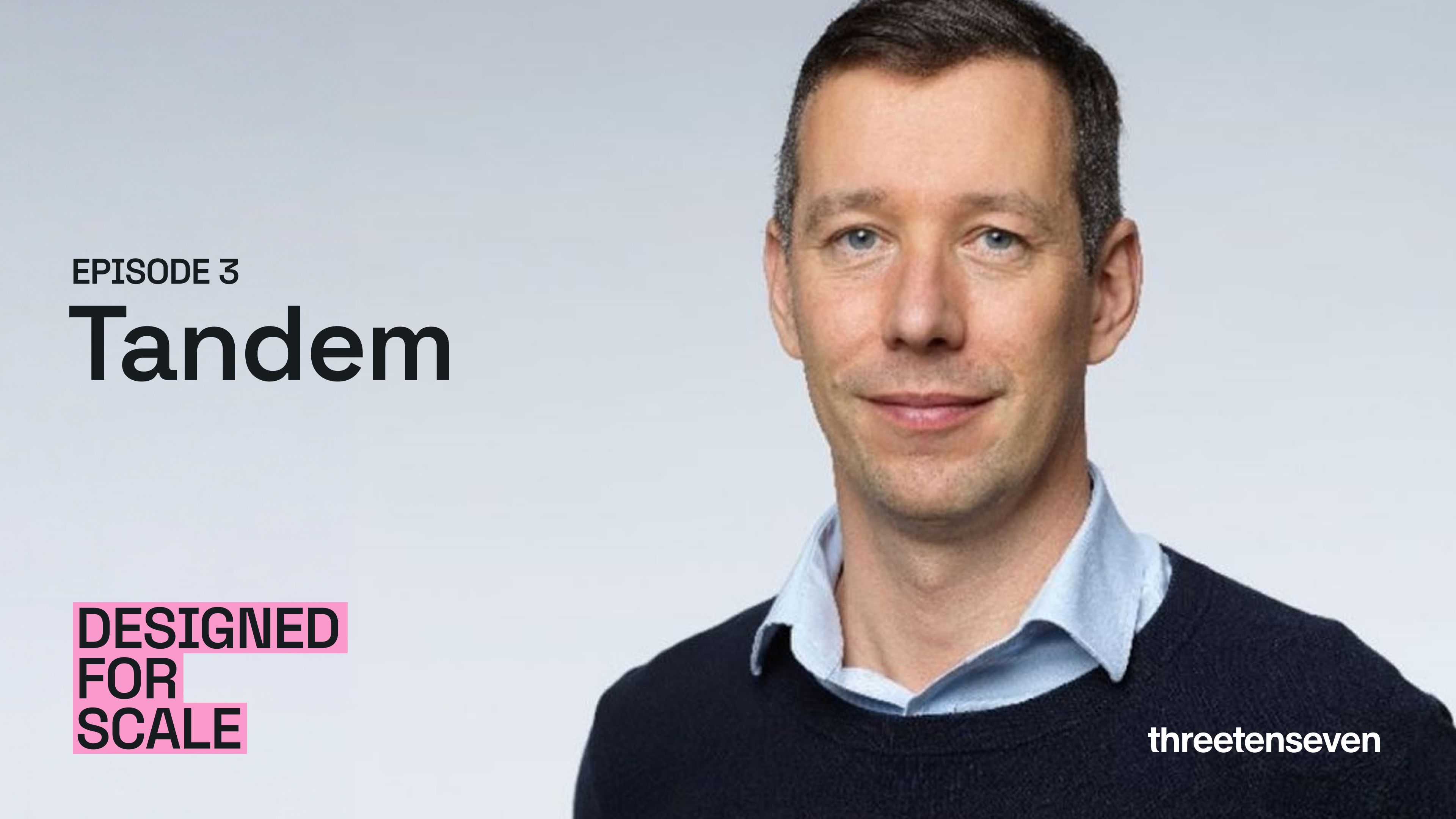
Episode 3: Oscar Boldt-Christmas Co-Founder Tandem Health
Tandem, a leading AI medical assistant, has seen incredible growth since launching in 2024. In our conversation with Oscar he breaks down the Day 1 mentality that made that growth possible, why feature expansion needs to be carefully managed, and what his background at McKinsey taught him that helped them tell investors a compelling story.
Rachel: Hello and welcome to Designed for Scale, the podcast where we speak to CEOs, founders and entrepreneurs about how they built and scaled their health tech business. I'm Rachel Burrell-Cook, Managing Director of ThreeTenSeven.
Paul: And Paul McGuigan.
Rachel: This week we're joined by Oscar, who is co-founder of Tandem. Oscar, would you mind introducing yourself?
Oscar: Hello and great to be here. So I'm Oscar Boldt-Christmas. I'm one of three co-founders of Tandem Health. Before doing this, I was 20 years with the consulting firm, McKinsey & Company, where I led the European healthcare practice. And Tandem today is, we call it an AI clinical operating system. And basically saying that, how can we help clinicians with everything they do that is not being with the patient? So that means generating notes, generate coding, generate the clinical decision, managing the different tasks. So basically saying, how can we free up everything that is not with the patient or making decisions around the patient? Today we are around 150 colleagues, across 10 different locations in Europe. And an interesting fact is like, about half of the colleagues we have are clinical colleagues. So we really believe this is less about technology, more about clinical knowledge to deliver a really good product.
Rachel: And you've grown fast, I think it's fair to say as well. How long have you been in operation, Oscar?
Oscar: So we started two and a half years ago. So this was in August 2023. We had the company set up just like in that month. And then the first paying customer in November 2023. So roughly two years of real operation.
Rachel: Which is exceptional speed. I'm really interested in what that looks like day to day or how you particularly in your role have managed that growth at such a speed.
Oscar: Yeah, I mean, sometimes I wonder myself as well, but I mean, first of all, I do think there's something about just having this sense of urgency from the start. We knew this was gonna be a fast moving market. We knew, I mean, the paradigm of GPT was happening. We knew that it was gonna move quickly. And we just knew we need to move fast.
And I think a second part was that we came from a small country based in Sweden, the head office. And we knew Sweden was gonna be too small regardless. So we really said, we're gonna build this from the start to be able to work in Europe across markets and all the processes we set up need to function in multiple geographies. And this was simply because we knew this was gonna happen quite quickly going out to Sweden. And therefore we need to prepare for this.
So I think that was one big part. And also we had the luxury of starting fresh and with the new technology of generative AI, but that meant not only for our product, we could also say all the processes we do as a company, how can we have AI being part of this? How do we do outreach to customers? How do we do customer support? So basically saying, can we be AI native, not only in how we do our product to the market, but also our internal processes. I think that has helped us really well to almost have that mindset. We're gonna be there in two years from now. What are all the things we don't need to recruit humans around but really have an AI first policy.
Rachel: Really interesting. I love the idea that it's really living your product and your ethos internally as well as in the end product as well. I think I can see how that could really build a culture that is gonna benefit everything right the way through to how the product develops over time. And it sounds like the product is developing quite rapidly as well. It's not just sort of scaling to sell what you've already built, but also keeping developing. And you talk about going from a medical scribe to a fully fledged medical assistant. Can you talk to us about what that development means and what it looks like?
Oscar: Yeah, so clearly the scribe was sort of the launch product and that simplicity in itself was a beauty, right? I mean, you understand what it is, it's containable. The ask of our colleagues out in the market was really simple. We could say, okay, this is the product. You understand it right away. The decision is small, containable, just go for it. But obviously there are so many natural adjacent use cases. If you have a perfect recording of a conversation and have that clinical note, I mean, obviously then you have the tasks that come out of it. You can give advice on what's been said, was this the right medical decision or not? You can do the coding. So the models are in a way very synergistic and adjacent to the core use case of ambient scribing.
And we are basically developing that full roadmap based on the discussion with our clients. We always ask, okay, now we have a note being generated in like 5% of the time versus before with better quality. What else do you spend time on? That means that you are not with your patient or thinking about the decision around your patient.
Rachel: Really interesting, yeah. So did you find your initial clients, were they buying into what you offered right now or were they just as much buying into where you were going in the future?
Oscar: Initially it was very much the ambient scribe, I would argue. And I think that was a blessing. Again, anyone coming to the market selling a platform is just a completely different discussion. This becomes a CIO discussion. We already have a platform. It feels very sort of cumbersome and quite a lot of decisions need to be made. The scribe was containable and manageable and quite small in scope.
But as the market now matures, I would argue we have two categories of customers. One who are still saying, okay, we need to scribe it. This is what we want to discuss and we want to find the best scribe in the market. But more and more customers are doing exactly what you said — they're thinking, well, this is going to be a roadmap of things. If we're going to evaluate you as a partner on your regulatory stance, on your cybersecurity, we can't have five partners. What does your roadmap look like? Because we want to choose a partner for multiple use cases. And you see this more and more happening with the more mature customers that are choosing a partner. And the question is rather, is this partner going to be our underlying core system like the EHR, or is it going to be an independent AI native like a Tandem Health.
Paul: So you have to be quite adaptable in terms of what the relationship is going to be with the customer, the kind of partnerships that you're going to have. And we've seen obviously here in the UK, the partnership with Accurx has been instrumental to your speed of adoption here, right? Can you talk to us a little bit about how that came about and what that relationship looks like?
Oscar: We knew the UK would be an extremely competitive market. There was already, and as by the way, it still is probably the most developed in terms of scribing. And we knew of Accurx of course, and we were extremely impressed by them, particularly they had a solution in the market that is really loved by their users. They have a loyal following, which can't be said for all solutions in healthcare. And it came to us that we knew they were looking for a sort of technology partner. They said, we're going to work with the best in doing a scribe, not going to do it ourselves in house necessarily, and we're going to focus on what we do. And we struck up that dialogue after a long courting period — well, long, a month or so — but we really looked under the hood of each other's operations. We partnered together, and it's been, I think, a very successful partnership on all accounts for both parties.
Paul: And are you pursuing that same partnership model in other territories, countries at the moment?
Oscar: Yeah, so a few different partnership groups. We have those that have an Accurx, which is like an independent platform, like a middleware kind of thing where we partner with those players. We have partnerships with EHRs, so that is directly with the electronic health record players. And then we have partnerships with pure resellers, people who are today selling equipment or solutions into various clinics, and we're partnering with them.
And I would say that our experience so far has been that a partnership with Accurx is really, in a way, the exception. Overall, I think we have learned that partnering always means someone doing it slightly worse than you would yourself. And I'm not saying this in a dismissive way. They will never be as passionate about our product as we are. They will never be as hard-challenged to really try and get into the market. So I think the experience has been that if you're gonna get something done really, really well with quality, you actually have to do it yourself. And then there are exceptions to that rule, of which the Accurx collaboration is one.
Paul: So there's a sort of trade-off between — it's a really rapid way in, presumably, to partner, they give you scale pretty quickly, but it means that you can't control every aspect that you could maybe feel like you could add additional value. And presumably, does it hurt at all to sort of see it referred to as the Accurx scribe in the branding, as opposed to it being seen as Tandem?
Oscar: So it's Powered by Tandem, if you may, please. But of course, I mean, you're putting your finger on what it is, right? I mean, you are one degree separated from the customer who's, at the end of the day, the end goal at any point. I mean, how do we have a super happy customer with our product? And if you are next to them, you can control it, you can react. One degree of separation means exactly that. You're slightly slower, there is a certain distortion of the facts that are flowing. So I would argue that it is the exception to prove the rule. If you have a really good partner, and the way we have set it up with our friends in the UK is really to be fully transparent, and we're really operating like one company with one market, and that way it's working really well. But that kind of partnership is not that easy to get in practice.
Paul: Perfect being the enemy of good and all of that — that was the best way to get established and get a foothold quickly in the UK, presumably. But as you now grow and are able to develop more opportunities, that presumably allows you to have a little bit more control over exactly what you're describing there and be able to compromise less in terms of how you're adopted elsewhere in the future.
Oscar: I mean, clearly, if you plan for everything in a certain way and no action happens, that's even worse. So for us, for the UK, that was exactly the right route. But I will say again, the core of this was the fact that Accurx was a really trusted and loyal brand and had already achieved what we are trying to achieve — having users that love them and a strong brand. If that were not in place, we would never have done it, regardless of what kind of coverage they had. I mean, you could argue that some of the EHR players have very good coverage as well, but it doesn't mean that we necessarily always can partner with them because they don't have the same relationship with the end customers.
Paul: And you've got the brand trust angle to consider as well. So it's not just about reach, it's also about who do we want to align our brand with, who's saying the right things, who's going to make sure that we look the way that we need to look in front of our customers as well. Accurx have got that fantastic reputation. I think from a brand point of view, shoulder to shoulder with them makes a lot of sense.
Oscar: 100%. And also we have to play this state forward. I mean, if you look across Europe, the main owner of the IT stack is typically the EHR player. Typically, and I'm generalizing now obviously, they are not seen as really great customer custodians. They are a bit slower, they are there for a long time. Customer support might not be perfect. So I do think that we have to think a bit, also five years from now, who will actually be the product in the market that the customers interact with? Will it be the EHRs or will it be newer solutions that are living in parallel or on top of EHRs? And we need to start thinking about that already now. The route there might need some compromises to get distribution or get partnership. But I do think we have to understand that certain things are better done from scratch than trying to sort of build off a legacy system or a legacy relation or a legacy way to interact with the customer.
Rachel: And certainly in countries like the UK, where we are trying to unpick years, decades of a service that could be improved, that is a really hard challenge to pick up on. It's gonna take a long time before we change over here. But I'm assuming that in other countries — the US where things are more fragmented and private based, or India, for example, which is a newer health system — is there more opportunity in countries like those than places that are more established in public health systems like the UK?
Oscar: I would argue, I mean, I will still say that those that are a bit more advanced in terms of healthcare systems are also more advanced in terms of adopting this. I mean, you could be the point in case — you are on European scale the leading one in this adoption. But you have a point that in some systems that are sort of a bit newer or maturing a bit later, we see customers doing almost like a jump. They never have a legacy system. They go straight to a web-based solution or can almost skip an evolution step and go straight for some of these solutions. Estonia is a good example, which is very modern IT infrastructure. And then you can see them more quickly and earlier on adopt these kinds of solutions.
But in general, I would still say the systems that have already came a long way with the EHR set up will also be quicker on these solutions because there's something to build around. There's a pedigree of work and you have users out there who know what an electronic healthcare record is. I mean, some markets — we had a discussion the other day, somebody said, "Where do we put the fax number in the end profile?" And literally faxing documents between practices, which is common in some European countries.
Rachel: I hear that the last NHS trust in the UK got rid of their fax number a couple of weeks ago, actually. So yeah, that's taken until 2026 for us to officially get rid of fax machines from the NHS in England. So well done us.
I'm really interested then in going back to what you were saying earlier about the evolution of the product. Because you were saying how important and how useful it was in the early days to have that real clarity and simplicity of proposition. You know, it's a scribe and everybody understands that. No matter the maturity of the system that you're selling into, you can explain the benefits — it saves you time on the admin burden, which we know can be extraordinary, you know, 40% of a clinician's time, which is crazy. But you've talked about how it's evolving from something where you can click start, finish, make notes, check the notes, upload to EHR — simple, I understand that — and now you're layering on these additional functionalities that allow you to help with coding, help with all the next tasks that a clinician needs to take after a consultation. How are you handling the evolution of that proposition? Because you've talked about how that simplicity has been so vital in that initial adoption phase, but now it's becoming a little bit more of a complex proposition, a more nuanced set of messages. And presumably, given the benefit you've had from simplicity and clarity, that comes with some challenges and some trade-offs.
Oscar: 100%. And it's actually a very concrete thing. Like when somebody asks, what is your product, right? Do you talk about the scribe and then you postpone the other discussion, and then you have the same model reaction. So listen, here are the five modules, right? And there are two very different discussions with different reactions from our customers. And I think the short answer is, we are at that point now, we need to talk about the full range. And the market has also matured to ask, well, we heard that this and this is coming, how do you think about it? And they want to have the synergies between the modules as well. So I do think we're just moving very quickly there.
In a completely new market or with a customer that is new to this, we still always lead with a scribe and say, do you know we can write your notes for you and you can free up 40% of your day. And that is the initial discussion. Again, so tangible, so easy to demo, people can try it out and immediately understand the value. And then in meeting two or three, we can discuss what does this mean downstream and upstream from that kind of meeting. So I think it's a bit of a dual approach depending on the maturity of the customer.
Paul: Yeah, it's really interesting actually, because I was thinking about how you land the message slightly differently with different audiences, because I was at a dinner the other night and there happened to be a couple of doctors on my table. And I knew that I was going to be speaking to you. So I raised the subject of AI medical scribes. And they happened to not be using any of this technology yet in their workplace. And they were really receptive to the idea of course, that it's going to save them lots of time — time that they can better spend doing other things. But I think there were two barriers that I could see that you'd have to overcome in your messaging. One being that they're very overloaded, and the idea of having to learn a new technology or a new system was quite daunting. So landing the message that actually it's not going to be really disruptive and have to spend loads of time learning something new. And the other was not going in too hard with, "and therefore you're going to be able to see lots of additional patients," because they already feel so overloaded with the workload of seeing as many patients as they do. Whereas you can deliver that message at a system level.
Oscar: I mean, I think it's spot on. And I mean, I was a consultant for 20 years before, as I said, and I think many of the solutions we had before were always trade-offs between different outcome vectors. You say, here's a tool that would increase productivity, but it actually costs a lot of money in the end for other parts. So it's going to be slightly impeding on patient safety, but we're going to have better something. But it was always trade-offs between different outcomes.
With these technologies, I think for the first time, we have things where you can have better productivity, better work environment and better patient safety. You can have them all. But the question still remains as you say — let's say we harvest these values, especially the productivity one. How do you harvest this in the actual clinic? I mean, the proposition to just say, "you get this tool, if you see two more patients a day" — I don't think that is the recommended approach to doing this. And we've had very concrete cases and customers doing that. And it is just the worst one. But the good news here is that the numbers are so big. So if you just do it, you will harvest the value. I mean, if I told you, you get 40% of your day back, we can debate whether 20% of those are meant for new patients and the rest for coffee or more research. I mean, the numbers are really big. So there will be more than enough to go around to do something really meaningful and better the healthcare system. So for me, it is not the big problem. It's rather the fact that we for once have a solution that ticks so many boxes and delivers value almost with no trade-off.
Paul: One thing that strikes me about talking with you, Oscar, is how — and I mean this as a compliment — how different you are to many other founders that we come across. And I wonder if that's because of your McKinsey background. And this is not to diminish any of the other brilliant founders we've spoken with on this podcast, but you have a very structured approach to growth. From what it sounds like you have a very structured journey that you've taken from day one, two and a half years ago, to where you are now — and the growth stories and the numbers that people will have seen in the press. I can't help but draw a line between those two things. Do you think it is the McKinsey in you that's bringing this structured approach to Tandem? Did you set out with a very clear go-to-market strategy, but also a growth strategy for the first say three to five years?
Oscar: First of all, I should note for the record that Lucas, one of my other co-founders is also an ex McKinsey, although significantly younger than me, just to be clear on that. But of course, I think, I mean, it's difficult to know what you bring into something like this. But I think one thing we knew — and I don't want to sound too cocky on this — but we knew it was going to go fast and we were going to be quite successful. So it was almost like we could plan for year two from day one. We didn't need to sort of take one step at a time and see how things evolve. We can almost plan what is the future state of our organisation and start to build it from day one.
I think that makes the world a bit easier. If I could tell you, I guarantee you, you will be at this point two years from now and you really feel it, then of course, it makes many things much clearer when you plan ahead. Because you can take that date and almost decide what does this mean for minus one year, what does it mean for minus 18 months. A good example of this is recruiting, right? If we say we are going to be active in these markets and we're going to have a certain market at number one, number two, well, it means we need 10 people in France. And if we have 10 people in France by that date, we need to start now, and this needs to be the profile, and this is the order. So I do think we had a pretty high degree of structure. And I think this is what our investors and others felt — that we knew sort of what we were doing. And hopefully we are trying to execute on it. Now it sounds like we were like some kind of robotic machine. I mean, obviously there were lots of uncertainties and things we had to change along the way. But for sure we had a pretty clear future vision of where the company would be from day one.
Paul: I bet that gave investors a lot of confidence as well, because investors come across so many different people in a very different way, of course — but often people who may have clinical backgrounds, who have a brilliant idea of what the need is, but not necessarily the structured solution to help them meet that need. Whereas it feels like you identified the problem and the solution quickly and were able to talk about how you were going to monetise that, mobilise that, and so on. I'm certainly assuming so, but I'm sure there's loads of nuance and difficulty as you've hinted at along the way. But what was it like? What was your investor journey like? Can you talk to us a little bit about that — when you took investment, what your intentions were and how that supported the growth?
Oscar: Yeah, so our seed round was in May 2024. And the main investor there was a company called Northzone, which is really one of the leading VC firms in the world. They happen to be based in Sweden, but they were among the first investors in Spotify and other things. And Jørgen Lund, who was on board, was literally one of the very early investors in Spotify. So they came with a very good background and reputation. And for us, I think there were two things behind why we had a relatively positive investor story. One was that we had paying customers early. So we really went to say, I mean, if you have paying customers, then you've proven something. It is a big difference to have free pilots — whatever — but if you have someone saying, "I will give you money because of your product," then that in itself is valuable. So we had a good customer growth of paying customers. And secondly, we had a clear vision of what we would do with the money we bring in. I think maybe that is sometimes what is confusing — like people just want money, but if you can't articulate very clearly exactly what kind of growth will this fund, where is it going and where will it be two years from now? And I think we did that pretty well.
And in May we did our first round. And then almost exactly a year later, in May 2025, we did our second round, which was 50 million US. And the lead investor there was Kinnevik, which is a Swedish conglomerate group, and Northzone again being part of that journey, together with some other very strong investors.
Paul: It sounds like it was probably a real decisive factor in getting that funding, because I think it's fair to say you weren't, at that stage, the only show in town — there were lots of other people sort of looking to innovate in this space around medical scribes. And I remember you coming back, Rachel, from Health Europe, saying there are lots of people there talking about this technology. And we were sort of speculating about what might have been some of the breakthrough things that saw you scale at pace compared to some of the others — and perhaps some of that clarity around what you wanted from investors and what you were going to do with that investment might have been partly the edge that saw you into a position where you were able to scale faster than they were.
Oscar: Yeah, I mean, there are still something like 140 scribes, I think, last we checked in the market, right? I mean, the three of us could build a scribe probably in an evening if we wanted to. I mean, the game is now becoming more of a product game — this is a product that is good enough and actually works in the real world. So I do think the game is now bifurcating a little bit between those who have a certain weight. And you can only get the product from 60 or 70% to a 98% product if you have customers, because the feedback from the market, everything you learn when you have tens of thousands of users versus having 100 is just such a different world. And I think for us, that sort of tuning — having more and more customers, adapting the product to be better and better — that kept us a little bit ahead of the game. And then of course that brings the funding, which in itself defines the market, who gets funding versus not, because you can accelerate even further and the market sort of splits up into two different camps. So I would argue at this point in time, there are less than five or so companies that matter in this field as true competitors.
Rachel: So you're really having to listen to those customers and clients that you have got now and what they want, what improvements they'd like to see. I noticed you'd introduced a sort of template builder feature, which allows the community to sort of build templates that suit how they want to work and how their systems work. And that sounds like it's an example of that sort of thinking — going, let's make sure the platform develops in a way that actually responds to how people want to use it and how they want to see us develop the product over time.
Oscar: Absolutely. I mean, in the early years, we literally spent time out in the clinic sitting next to the doctors that we collaborated with, right? Because there are just so many ways — even if we have many doctors employed — that you assume how the product is used. And typically also when you're at a certain size, customers who are not happy just churn away. You need to look at those that are becoming unhappy customers for whatever reason and learn from it. And it's very easy to hear from those that are happy — you do an NPS or something — but we are obsessed about tracking NPS scores. And literally we have a feed of all the NPS. And if it is a six or below, we will reach out to that customer and ask, "Why are you not happy? What can we do differently?" And we do it for that customer, but typically also because we know if that customer is not super happy, there might be 10 or 20 like them saying the same thing.
And I think this is the customer obsession piece — but understand that we have the benefit of sampling this all the time. The right answer is not to say, "This is only one person saying this." Well, it's very seldom that that's the case — it's typically an indication or a canary in the mine for other customers having the same issue. And we try to be really quick on this and turn it around.
And that sort of talks to another part of this industry that is quite cool — people are so unused to getting good feedback and response and getting things fixed in IT. So when people have a concern or something that is not working perfectly and we can fix it within 24 hours, it's just a new world for them. Because normally they're used to nobody fixing something or very long lead times to get something fixed. So I think also we are in that way in fertile ground — just being responsive to the market, people appreciate this and can live with something not being perfect from day one, but as soon as they feedback, we fix it. And then you create a very loyal following based on that.
Paul: Absolutely. I mean, we say this in sort of brand and marketing quite a lot — that those moments where you can turn around a negative experience are far more likely to build loyalty than it takes much more time to do it without being able to turn around a negative experience. It's really useful. Have you learned anything surprising, or that's really made you change something significant, as a result of customer feedback? Or has it all been quite iterative and steady improvements?
Oscar: I think the hardest part of this is to say no, right? Not to do things. I mean, we get lots of feedback — "it would be nice if" or "I would like to have this," right? And we always have to ask ourselves — this is obviously a customer request. But every time you mess with the interface, the UI, you create complexity, you create uncertainty about exactly how to use the product. And the beauty of having a product that people immediately understand, where they literally understand 80% of the functionality they see on the screen — that is a massive value in itself. Therefore, the conclusion is not always to add features or accommodate. Rather say no, until we're really sure this is a wider need. But when it is a wider need, then be quick to implement it and get it out there.
And the second part is that we are really trying not to fork the product. We try not to have different versions of Tandem in different countries that feel and look different. And the challenge we face here of course is that the traditions and preferences might differ. So do you write longer notes or shorter notes? Do you have more medicalised language or more patient-centric language? And that is why we land a solution like the template builder you mentioned, where customisation or adaptability becomes important. So you can have one product, but actually then catering to local needs — not because of a fix in the product, but really built into the product to have that adaptability. So we understand what things to adapt to versus what things to just standardise.
Rachel: This is absolutely fascinating. I've got so many more questions, but I'm aware that I need to keep time here as well. So we've just got a couple more questions for you. Looking back, what's been the hardest operational challenge when it's come to scaling Tandem? The one that people possibly don't see or haven't seen.
Oscar: I think it's very easy to put this as a sales motion, right? How can we sell? And then when somebody has signed something, they are a customer. This kind of product, I would argue, is relatively easy to get someone to sort of sign up to and like, and even like the procurement, etc. But then you need to have a happy and loyal customer. And we are working with clinicians and critical colleagues and it's just very hard to meet all the requirements. There are different dialects. There are different patient groups, different situations. And also there's a basic relatively high scepticism of some of these tools from the start.
So I think the biggest thing is that 80% of the effort for us is really from signing to getting them to be loyal, happy customers who say, "This is an NPS 10, I really like Tandem." Whereas the sales part — of course we need to get there — but that's relatively the smaller part of the journey in total for us. And that's also important. There are quite a few solutions out there that are just free to try for as long as you want. And we will have a bit of this, but having someone who is a paying customer says, "This is real value, we're willing to pay for this," and sign up on this journey with you — that is a different game, and it's one that is won after signing, not before.
Rachel: Final question — we always ask our guests to pay it forward. I would love to know which other health tech company you think has got a growth story that's really worth telling. Is there another founder or CEO, COO, who really needs to have their growth story shared? Who would you recommend?
Oscar: I mean, of course I've already spent a lot of time with them, but I would say Jacob Hader at Accurx is a perfect person — just because of how do you build a company with such a loyal following in such a conservative industry in many ways. So I would absolutely bring him on if you haven't done it before.
And then, even would you say someone in health tech that is not an entrepreneur but is just an important person — I would say Penny Dash, the chair of the NHS. This is someone who actually has a strong view on how this will impact healthcare. And I always find it interesting to listen to her and her putting her chin out a little bit on some of the questions that will form our industry. So those two, I would absolutely listen to.
Rachel: They are such good recommendations, and especially Penny Dash — for being a complete badass as well. I saw her talk last year and I thought she was just fabulous and fierce in all the right ways that we need to reform the NHS. So I think she's great. Am I right in thinking you worked with her at McKinsey?
Oscar: 100%. So I got her role — she left McKinsey, I had a role at McKinsey, and worked with it for 15 years. What a colleague.
Rachel: I know. Fabulous. Thank you so much. As I said, I think it's just a fascinating journey that you've been on with Tandem. I can't wait to see where you can go from here. If you've achieved all this in two and a half years, I'm sure the growth story is gonna be amazing over the next two and a half. So thank you so much for sharing. We're really looking forward to sharing your story.
Oscar: Yeah, thank you. Let's book our slot in two and a half years from now and we take stock where we're at — absolutely in the diary.
Paul: Thanks, Oscar.
Oscar: Very good, thank you guys, bye.